
Someone above you wants to know what a private 5G network will cost. They want a number they can defend. This guide gives you the ranges, the line items behind them, and the Canadian details most cost guides skip.
We wrote it for IT, network and operational technology (OT) leads in mining, energy, utilities, ports and airports. Every spectrum figure uses ISED’s 2026-27 rates.
Key takeaways
- Total cost: US cost guides put a typical enterprise build at about US$250,000 to US$1.2 million (roughly C$350,000 to C$1.7 million). Small, targeted sites start lower. In 2026, the City of Kelowna set a $250,000 budget for a turnkey private network at its airport.
- Largest line items: radios and site works, the core network, devices, and integration.
- Spectrum: an ISED local licence usually costs between $50 and about $1,500 a year, reaching up to about $6,200 for a large rural site at the maximum 80 MHz limit.
- Running costs: US guides suggest about 15% to 20% of the build cost each year for support, software and maintenance.
- The biggest variable is how much ground you need to cover, and in what conditions.
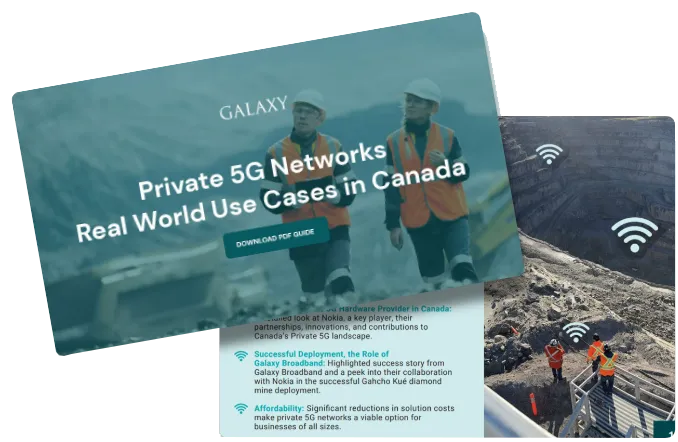
The Gahcho Kué Diamond Mine case study shows how private 5G improved performance, connectivity, and safety in a subarctic environment without relying on public mobile or fiber infrastructure
What you are buying
A private 5G network has six key budget items: spectrum, radio access network (RAN), core network, devices, deployment, and ongoing operations.
Key cost components of private 5G
ISED fees are in Canadian dollars. Hardware benchmarks come from published US cost guides. We converted them at about C$1.40 per US dollar (September 2026).
| Cost element | What it covers | Indicative range | What drives it |
|---|---|---|---|
| Spectrum (ISED NCLL) | Annual local licence | $50.14 minimum up to $1,500 for a standard licence; up to $6,204 for 80 MHz | Licence area, bandwidth, urban, rural or remote rate |
| Radio access network | Radios, small cells, antennas | US$10,000 to $50,000 per small cell (about C$14,000 to C$70,000); US$100,000 to $200,000 per higher-power base station (about C$140,000 to C$280,000) | Coverage area, terrain, device density, rugged hardware |
| Core network | On-site, edge or hosted core | Priced per project, as capital or a subscription | Standalone or non-standalone (where LTE anchor exists), redundancy, host location |
| Devices and endpoints | CPE, handhelds, IoT modules, SIM or eSIM management | Scales with device count | Number and type of devices |
| Deployment and integration | Site survey, civil works, power, installation, IT and OT integration, testing | Site-specific, heaviest at remote sites | Power, access, integration depth |
| Ongoing operations | Managed service, network operations centre (NOC), support SLA, software, renewals, spares | About 15% to 20% of initial capital cost per year | Support tier, SLA, network size |
Radios carry the most variance. A campus might need a handful of small cells. An open pit might need fewer, higher-power radios on masts.
The core is where the delivery model matters most. An on-site core is a capital purchase you own and maintain. A hosted or managed core moves most of that into a monthly fee.
A standalone (SA) core runs 5G end to end and supports network slicing. Because the NCLL band is 5G only, a network built on NCLL spectrum alone is standalone in practice. Non-standalone (NSA) uses an LTE radio and core as its anchor, which suits sites upgrading an existing LTE deployment on other spectrum.
Deployment costs depend on the site. Remote builds often need new power and masts before a single radio goes up.
Costs that often get left out
These lines often show up after the first budget:
- Backhaul: a remote network still needs a link to the outside world. At many northern sites that means satellite, such as OneWeb LEO.
- Renewals: the ISED licence renews every 31 March, and core software and support contracts renew on their own cycles.
- Device charges: if your core or SIM platform charges per device, that cost grows with every sensor you add.
- Spares: at a fly-in site, a failed radio waits for the next flight unless a spare sits on the shelf.
Want a budget built on your site instead of a benchmark? Ask a Galaxy private 5G specialist for a costed assessment.
Get our whitepaper to learn how companies are deploying private 5G for productivity, safety, and automation.
Spectrum: what ISED local licensing costs
Canadian buyers license their own spectrum through ISED’s Non-Competitive Local Licensing (NCLL) framework. There is no auction. ISED reviews applications first come, first served, and aims to issue a licence within 12 weeks.
The first NCLL band is 3900 to 3980 MHz, split into eight 10 MHz blocks. Licences expire each year on 31 March, and you can renew them.
There are two licence sizes. Low-power licences cover up to 15 km² anywhere in Canada. Medium-power licences cover 75 to 165 km², in rural and remote areas only.
How the fee works
The annual fee is spectrum (MHz) × licence area (km²) × a base rate. The rate depends on how ISED classifies the area: urban, rural or remote.
For 2026-27, the 3900 MHz rates are $1.88 (urban), $0.47 (rural) and $0.01 (remote) per MHz per km². Every licence has a minimum fee of $50.14 a year. Fee Order SPB-003-23 sets the formula, and ISED adjusts the rates periodically.
| Example site | Licence | Area | Annual fee (2026-27) |
|---|---|---|---|
| Urban factory campus | 20 MHz, low power | 10 km² | $376 |
| Rural processing plant | 20 MHz, medium power | 75 km² | $705 |
| Remote mine | 20 MHz, medium power | 165 km² | $50.14 (the minimum) |
| Rural industrial site, industrial limit | 80 MHz, medium power | 165 km² | $6,204 |
More spectrum for industrial sites
Under SAB-03-25, the standard limit is 20 MHz per location. Mines, factories and warehouses can apply for up to 80 MHz. So can offshore oil and gas sites and 5G or 6G research labs.
To qualify for up to 80 MHz, you must already hold a 20 MHz licence in that area, and the expansion applies strictly to renewable licences (temporary pilot licences stay capped at 20 MHz). Additionally, the entire licence area must fall outside metropolitan Tier 5 service areas, and in urban settings, coverage is strictly limited to indoor use. Applicants must also control physical access to the whole area and coexist with nearby licensees. ISED expects to open a 40 MHz limit for rural and remote areas in early 2027.
ISED has also announced that local licensing in the 28 GHz band will open soon. The 26 and 38 GHz bands are still pending.
Pilot first on a temporary licence
ISED also issues temporary licences for anywhere from one day to 11 months. You cannot renew them, but they suit a proof of concept.
You pay 1/12 of the annual fee for each month, with a 2026-27 minimum of $4.18 a month. A three-month pilot with 20 MHz over a 10 km² urban campus costs about $94 in spectrum.
That lets you test coverage and applications before you commit the full capital budget.
Spectrum versus software licensing
Spectrum is the cheapest line in the budget. The larger recurring “licensing” costs are software: core licences, per-device subscriptions and support contracts. Keep them on separate lines so nobody confuses the two.
For a step-by-step guide to applying, download the Canadian enterprise guide to private 5G and ISED local spectrum.
How cost differs by use case
The same components cost very different amounts depending on the site.
Remote resource sites and open pit mines spend the most on capital. They cover large areas in harsh conditions, which means rugged radios, an on-site or edge core, and satellite backhaul. Spectrum is close to free at the remote rate.
At the Gahcho Kué diamond mine in the Northwest Territories, a private 5G network runs alongside OneWeb LEO satellite. Moving to LEO satellite let the mine switch off the microwave link it had used since opening in 2016.
Manufacturing plants and warehouses cover less ground but need more capacity. Automated guided vehicles (AGVs), dense sensors and low-latency control mean more small cells per square metre.
Ports, yards and airports cover wide outdoor areas for asset tracking, video and operations. Coverage and reliability drive the bill more than raw capacity. Kelowna’s $250,000 airport budget covered design, supply, implementation and management across airside, landside, terminal and remote facilities.
Oil and gas, utilities and linear infrastructure pay for resilience. Long corridors, redundant links and failover push costs up more than device counts do.
How to build a budget you can defend
Before you ask for quotes, gather the facts that set the price. Each one below moves the number, and together they let suppliers price the same network.
- Map the area: draw the boundary you need covered and note its size in km². ISED asks for the same outline, up to 12 boundary points, when you apply.
- Check the area type: ISED’s urban, rural or remote classification sets your spectrum rate.
- Count devices by type: handhelds, vehicles, fixed sensors and cameras, today and in three years.
- Set performance targets: note the throughput and latency each application needs, such as video uplink or remote equipment control.
- List what is already on site: power, masts, fibre and any existing backhaul.
- Decide on uptime: name the applications that must survive a radio or core failure, and how fast service must return.
- Choose the model: buy, subscribe or mix, so every quote arrives on the same basis.
Then ask each supplier to split capital and operating costs over five years. That is the number your CFO will ask for.
Buy or subscribe: capex versus Network-as-a-Service
You can buy the network as capital equipment or consume it as a managed Network-as-a-Service (NaaS) subscription.
Buying gives you full ownership and control over upgrades. It also needs upfront capital and in-house skills.
NaaS turns most of the build into a predictable monthly operating cost, with monitoring and support included. It suits teams that want to start fast or cannot secure a large capital approval. NaaS pricing depends on the deal, so compare quotes on a five-year total cost of ownership (TCO) basis.
Understanding private 5G ROI
Payback tends to come from a specific operational win, such as less downtime or safer haulage. In a September 2025 Nokia and Global Data study, 87% of industrial adopters reported a return within one year. The survey covered 115 enterprises in Australia, Germany, Japan, the UK and the US.
In mining, the case can be simple. Real-time tire pressure monitoring on haul trucks prevents costly blowouts and premature wear. As Galaxy’s Andrew MacKenzie puts it, “If you can save me $100,000 on tires a year, it’s a massive win.”
Explore more payback scenarios on our private 5G use cases page.
When is private 5G worth it?
Private 5G earns its cost where public coverage is missing or legacy radio holds operations back. It also pays where downtime is expensive. It rarely pays off for a small indoor site that Wi-Fi already serves well.
If you are still building the internal case, download our private 5G use cases whitepaper.
Converted US benchmarks put a typical enterprise build at about C$350,000 to C$1.7 million. Small, focused sites cost less. Ongoing costs usually run 15% to 20% of the build each year.
Very little. For 2026-27, the fee is MHz × km² × $1.88 (urban), $0.47 (rural) or $0.01 (remote), with a $50.14 minimum. A 20 MHz urban licence over 10 km² costs $376.
LTE equipment can cost less, but it cannot use Canada’s NCLL band. No LTE band covers 3900 to 3980 MHz. Mid-band LTE tops out at Band 43 (3800 MHz), so the NCLL band needs 5G NR (band n77) equipment. Our 5G vs LTE guide compares the two.
An on-site core is capital you own and maintain. A hosted core swaps most of that for a subscription. Compare both over five years, including renewals.
ISED aims to issue an NCLL licence within 12 weeks. Design, procurement and installation run alongside or after that, depending on site access and power.
Across large outdoor areas, often yes. Licensed private 5G radios cover far more ground than Wi-Fi access points. That means fewer sites, masts and power drops. For a small indoor space, Wi-Fi usually costs less.
Conclusion
A private 5G budget in Canada rests on a handful of site facts: area, terrain, device count and backhaul. Spectrum is a small, predictable line, while radios, the core and site works carry the weight.
Request a costed private 5G assessment for your site. Or see how Galaxy builds private 5G networks with Nokia.