
Browse portable terminals and flat-panel antennas. Filter by use case and deployment type to find the right mobile satellite internet setup.

Portable satellite internet connectivity is enterprise-grade broadband delivered via Low Earth Orbit (LEO) satellites to terminals that are not fixed to a permanent location. Unlike traditional satellite setups that require a permanent dish at a fixed site, portable systems can be set up at a temporary worksite in minutes, transported in a ruggedized case, mounted to a vehicle, or deployed from a vessel and then moved again.
Galaxy’s portable solutions connect to Eutelsat OneWeb’s constellation of 650+ LEO satellites orbiting just 1,200 km above Earth, roughly 30 times closer than legacy GEO satellites. That proximity is what makes the difference: latency under 70 ms, download speeds up to 150-195 Mbps, and an always-on connection that supports video collaboration, cloud applications, VoIP, and IoT telemetry in locations where cellular and fibre simply don’t reach.
Whether you’re supporting a fly-in mining camp in Northern Ontario, an emergency response command post, a vessel operating offshore, or a construction crew rotating through remote sites, portable satellite connectivity keeps operations running when no other option exists.
Mobile satellite internet for vehicles uses flat-panel antennas integrated directly onto trucks, rail cars, vessels, or other mobile platforms to deliver continuous broadband connectivity, often while the vehicle is in motion. Unlike portable COTP terminals that require the vehicle to be stationary, vehicle-mounted systems are engineered to maintain a live satellite link through turns, vibration, and changing terrain.
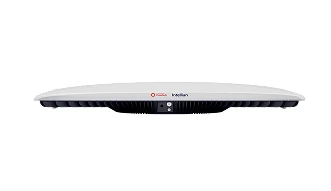
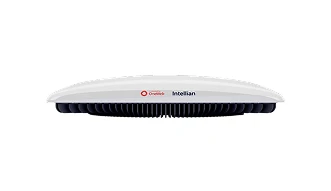
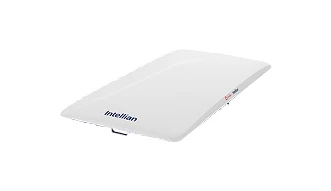
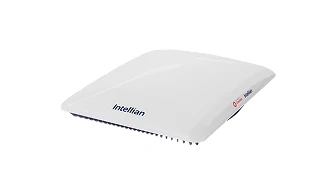
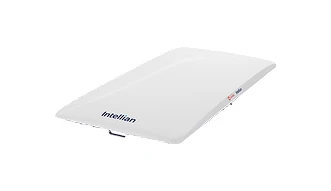
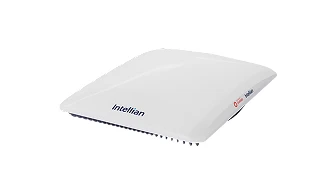
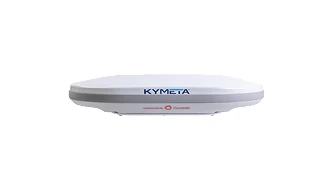
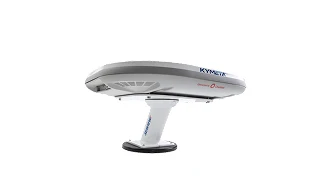
Galaxy offers a range of vehicle-ready terminals through its Mobile Commercial Network (MCN), including the Intellian OW11FV and OW10HV for land mobility, and the Kymeta Hawk u8, one of the few commercially available flat-panel COTM (Comms-on-the-Move) antennas on the market. These systems tap into the OneWeb LEO network to provide enterprise-grade connectivity at highway or rail speeds.
Practical applications include real-time fleet telematics, onboard crew welfare, safety monitoring, SCADA telemetry, and operational data sync, all without the driver or crew needing to stop. Galaxy’s MCN service layer adds private IP addressing, pooled bandwidth across your fleet, and 24/7 Canadian NOC support, so connectivity is managed end-to-end.
Yes, but only with hardware specifically designed for Comms-on-the-Move (COTM). Not every portable terminal supports in-motion connectivity, and using the wrong terminal type while moving will result in a dropped connection.
COTM-capable terminals like the Kymeta Hawk u8 (land) and Kymeta Peregrine u8 (maritime), along with Intellian’s OW11FV and OW10HV flat panels, use electronically steered phased-array antennas with no moving parts. They continuously track LEO satellites through speed changes, turns, and terrain variations, maintaining a live connection at highway or sea speeds.
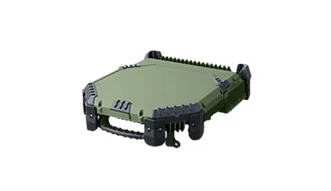
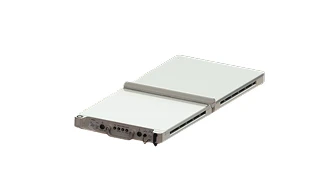
Terminals in the Galaxy Scout Elite, Intellian Manpack OW7MP, and Inster FoldSat LEO category are designed for Comms-on-the-Pause (COTP) operation. These terminals travel with your team but establish their satellite link once the vehicle or platform is stationary. For rapid deployment scenarios such as remote campsites, emergency staging areas, or fly-in field sites, COTP terminals are often faster to deploy, more portable, and more cost-effective.
Not sure which mode fits your operation? Browse the hardware collection above filtered by Land Mobility vs. Rapid Deployment, or contact a Galaxy expert to get a recommendation matched to your route, use case, and uptime requirements.
COTM (Comms-on-the-Move) and COTP (Comms-on-the-Pause) are the two fundamental mobility modes in enterprise satellite connectivity. Understanding the distinction is essential, as it determines which terminal you need.
COTM terminals maintain an active satellite link while the vehicle or vessel is in motion. Electronically steered or mechanically stabilized antennas track LEO satellites continuously through speed changes, heading shifts, and vibration with no human intervention required. COTM is essential for rail transit, commercial fleets, maritime vessels, and any scenario where dropping a connection during transit is operationally unacceptable. Galaxy’s COTM hardware includes the Kymeta Hawk u8 (land), Kymeta Peregrine u8 (maritime), Intellian OW11FV, and OW10HV flat panels.
COTP terminals are highly mobile and travel with your team, but the vehicle or platform must be stationary to establish and maintain a satellite link. Once stopped, these terminals acquire a satellite lock quickly and provide full enterprise connectivity. COTP terminals are typically lighter, faster to deploy, and more affordable than COTM systems, making them ideal for remote camp deployments, emergency command posts, fly-in sites, and field teams that relocate periodically. Galaxy’s COTP lineup includes the Galaxy Scout Elite, Intellian OW7MP Manpack, and Inster FoldSat LEO.
The right choice depends on whether your team needs connectivity while moving or only needs it once they’ve arrived. Galaxy’s team can help you confirm which mode, or combination of both, fits your operational profile.
The satellite terminal (antenna and modem) is the core of your portable connectivity system, but a complete operational setup includes several additional components. Here’s what to plan for:
Router / SD-WAN: Most enterprise deployments pair the satellite terminal with a managed router or SD-WAN device. This handles traffic prioritization (QoS), VPN tunneling, failover between satellite and LTE, and network segmentation between IT and OT traffic. Galaxy can configure and manage this layer as part of a complete solution.
Mounting Hardware: Fixed-site flat panels require pole or rooftop mounting brackets. Vehicle-mounted COTM terminals need professionally installed roof brackets rated for the terminal weight and aerodynamic loads at speed. COTP portable terminals like the Scout Elite, Manpack, and FoldSat include their own deployment hardware such as tripods, magnetic mounts, or integrated cases.
Power Supply: Power requirements vary by terminal. The Galaxy Scout Elite runs on standard AC power with an optional DC inverter for vehicle integration. Enterprise flat-panel terminals connect to vehicle electrical systems or site power infrastructure. Remote sites may require a generator, solar array, or battery backup. Galaxy’s team assesses power availability as part of site planning.
Service Plan: Hardware without an active service plan provides no connectivity. Galaxy’s OneWeb plans include Committed Information Rate (CIR) options that guarantee a minimum bandwidth level regardless of network conditions, as well as pooled bandwidth plans for multi-terminal fleets and static IP addressing for secure enterprise networking.
24/7 Support and Monitoring: Galaxy’s Canadian-based Network Operations Centre (NOC) provides proactive monitoring, real-time network statistics through a customer portal, and rapid-response troubleshooting. This is particularly critical for remote deployments where field technicians are not on-site.
Galaxy configures and supports the full stack, not just the antenna. When you purchase hardware through Galaxy, you’re getting a managed connectivity solution, not just a piece of equipment.
Eutelsat OneWeb’s LEO constellation of 650+ satellites provides complete coverage across Canada, including northern and Arctic regions that legacy GEO systems struggle to serve reliably. For the vast majority of Canadian locations on land, at sea, or along major transportation corridors, OneWeb service is confirmed and active.
That said, coverage confirmation for enterprise and government operations involves more than checking a map. Galaxy’s team reviews several factors specific to your deployment: operating locations and site coordinates including remote, offshore, or above-60N deployments; movement corridors and route profiles for fleet, rail, and maritime applications; terrain and elevation angle considerations where obstructions like canyon walls, dense boreal canopy, or mountainous terrain could affect line-of-sight; required performance SLA; and maritime zone profiles for nearshore vs. open-ocean operations.
To confirm coverage before you commit to hardware, speak with a Galaxy expert. We’ll validate service availability for your specific coordinates, recommend the right terminal and plan configuration, and ensure your team is connected before you deploy.
Performance on Galaxy’s OneWeb LEO network is a significant step up from legacy GEO satellite and from BGAN solutions previously used in remote operations. Here are the real-world benchmarks to plan around:
Latency: Under 70 ms from terminal to Galaxy’s Points of Presence, consistently. Legacy GEO satellite latency typically runs 500-600 ms. This sub-100ms latency is what makes real-time applications viable on satellite. VoIP calls, video conferencing, cloud ERP, SCADA polling, and remote desktop all perform reliably at these levels.
Download Speeds: Enterprise flat-panel terminals (Intellian OW11FL, OW11FV, OW11FM) deliver up to 150 Mbps. Portable COTP terminals like the Galaxy Scout Elite deliver approximately 50 Mbps. Peak network throughput reaches up to 195 Mbps in optimal conditions.
Upload Speeds: Typically 10-32 Mbps depending on terminal class and service plan tier. The Scout Elite delivers approximately 10 Mbps upload, sufficient for VoIP, video conferencing, and cloud sync.
Committed Information Rate (CIR): Galaxy enterprise plans can include a guaranteed minimum bandwidth floor, ensuring mission-critical applications receive dedicated throughput even under congested network conditions. This is a key differentiator from consumer-grade satellite services where speeds are best-effort only.
These figures support video collaboration, cloud-based operations platforms, VoIP telephony, IoT telemetry, and file transfers simultaneously across multiple concurrent users.
Timeline varies by terminal type and deployment complexity.
Portable / COTP Terminals (Scout Elite, Intellian Manpack OW7MP, Inster FoldSat LEO): These systems are designed for same-day or next-day operational readiness. Once shipped, your team can be online within minutes of unpacking with no field technician required. Galaxy can typically process, configure, and ship a Scout Elite order within a few business days.
Vehicle-Mounted COTM Terminals (Kymeta Hawk u8, Intellian OW11FV, OW10HV, OW11FM): Professional installation is strongly recommended. Vehicle integration including antenna mounting, cabling, router configuration, and system commissioning typically takes 1-2 working days on-site. Lead time from order to field-ready is generally 7-14 business days depending on hardware availability and site logistics.
Fixed-Site Flat-Panel Installations (Intellian OW11FL, OW10HL): Mast or rooftop mounting, cable routing, and full system commissioning typically takes 1 day on-site, with a 7-14 business day order-to-deployment window depending on permitting and site access.
Galaxy’s National Technical Field Services (NTFS) team handles installations across Canada, including remote and Arctic locations. For urgent deployments such as emergency response, disaster recovery, or rapid project mobilization, Galaxy can expedite hardware provisioning and field dispatch. Contact our team early to discuss your timeline and mobilization requirements.
For remote operations that require real-time responsiveness including voice, video, cloud applications, and telemetry, LEO satellite is significantly better suited than GEO.
The fundamental advantage is orbital altitude. OneWeb’s LEO satellites orbit at 1,200 km while legacy GEO satellites sit at approximately 35,000 km. That 30x distance difference produces latency under 70 ms on LEO versus 500-600 ms on GEO, a difference that determines whether real-time applications are viable or not. VoIP calls, video conferencing, and cloud-hosted operations platforms all require latency under approximately 150 ms to function without noticeable degradation.
GEO satellite still has a role where latency is not critical, or where high-throughput broadcast-style applications justify the trade-off. But for oil and gas, mining, construction, emergency response, marine operations, and fleet management where crews need to work the same way they would at a connected office, LEO has become the standard.
Galaxy’s OneWeb LEO network also provides a major coverage advantage in Canada’s far north. GEO satellite coverage weakens significantly above the 60th parallel due to the low elevation angle to geostationary satellites parked over the equator. OneWeb’s polar orbit constellation delivers full, consistent coverage to Arctic and sub-Arctic regions where Canada’s resource and infrastructure sectors operate.
Yes, and this is one of the key capabilities that LEO satellite technology has unlocked for remote operations. Legacy GEO satellite’s high latency (500+ ms) made VoIP calls choppy, video calls unusable, and cloud applications frustratingly slow. OneWeb LEO’s sub-70 ms latency changes that equation entirely.
On Galaxy’s OneWeb-powered network, enterprise teams can expect reliable support for VoIP telephony with call quality comparable to cellular, video conferencing on Microsoft Teams, Zoom, and Webex, cloud-hosted ERP and field management platforms, regular file sync and backup from remote sites, and continuous IoT and telemetry data streams for equipment monitoring and safety systems.
Galaxy’s service plans include Committed Information Rate (CIR) options and configurable Quality of Service (QoS) settings to ensure your most critical applications, whether a safety monitoring system or a crew welfare video call, always receive the bandwidth they need.
Portable and mobile satellite internet connectivity serves a wide range of industries in Canada, particularly those operating in remote, northern, or high-mobility environments where cellular and fibre infrastructure simply doesn’t exist. Galaxy’s hardware portfolio and MCN service support:
If your team operates where cellular ends, Galaxy has a portable satellite solution designed for your environment.
Both Galaxy’s OneWeb service and Starlink use LEO satellite technology and deliver meaningfully better performance than legacy GEO satellite. But they are built for fundamentally different customers.
Starlink is primarily designed for residential and small business users, offering a widely accessible self-serve model. It performs well for general internet access in many remote settings, but it operates on a best-effort network without guaranteed bandwidth, formal SLAs, or committed information rates.
Galaxy’s OneWeb service is purpose-built for enterprise and government requirements. Committed Information Rate (CIR) guarantees minimum bandwidth so critical operations aren’t degraded during peak periods. Private IP networking keeps enterprise and government data on dedicated, secure paths. Service Level Agreements (SLAs) provide contractual performance and uptime commitments. Galaxy’s Canadian-based NOC monitors every connection proactively around the clock. And the enterprise hardware ecosystem including Intellian, Kymeta, and Galaxy-branded terminals is engineered for industrial environments, extreme weather, and vehicle integration.
For resource sector companies, government agencies, and operators with mission-critical uptime requirements, Galaxy’s OneWeb service provides the reliability, security, and accountability that consumer-grade satellite cannot. See Galaxy’s Starlink vs. OneWeb whitepaper for a detailed technical and commercial comparison.
Yes. When deployed through Galaxy’s enterprise OneWeb service, portable satellite internet supports the security requirements of enterprise and government operations.
Galaxy’s network includes several layers of security: end-to-end encryption for data in transit; private IP networking that isolates your traffic from shared public internet paths; static IP addresses that enable secure VPN tunneling and firewall whitelisting; logical network segmentation to separate IT and Operational Technology (OT) traffic; Canadian-based data infrastructure supporting data residency requirements for regulated industries; and SD-WAN integration that adds additional firewall, traffic inspection, and policy enforcement capabilities.
For classified or highly sensitive government communications, satellite connectivity is typically one component of a broader layered security architecture. Galaxy’s team works with enterprise and government clients to design configurations that meet specific compliance and security requirements. Speak with a Galaxy expert to discuss your security framework.
Both. Galaxy’s portable satellite solutions are deployed as primary connections, backup/failover connections, and in hybrid configurations that serve as both simultaneously.
As a primary connection, for remote sites with no cellular coverage and no fibre access such as fly-in mining camps, offshore platforms, northern construction projects, and Arctic research stations, satellite is the primary and often only available connectivity option. Galaxy’s enterprise plans with Committed Information Rate (CIR) are designed specifically for primary-connection use cases, guaranteeing the bandwidth and uptime your operations depend on.
As a failover connection, for sites with existing fibre or cellular connections, a satellite terminal provides an always-available backup path. Galaxy’s SD-WAN and GalaxyOne bonded solution monitors the primary connection and automatically switches to satellite in the event of an outage, typically in under a second, preventing dropped VoIP calls, interrupted cloud sessions, or gaps in safety monitoring data.
As a hybrid or bonded solution, Galaxy’s GalaxyOne platform can bond LTE and OneWeb LEO connectivity simultaneously, combining both paths to increase aggregate throughput and eliminate coverage gaps as teams move between areas of cellular availability and satellite-only territory.
Galaxy’s team will help you design the right topology based on your uptime requirements, existing infrastructure, and operational environment.
Yes, and this is one of the most important advantages of OneWeb LEO satellite connectivity over legacy GEO systems in Canada.
Legacy GEO satellites orbit directly above the equator at 35,000 km altitude. From locations above approximately 75 degrees north latitude, the elevation angle to these satellites drops so low that terrain, structures, and the Earth’s curvature begin to interfere with the signal, making reliable GEO connectivity difficult or impossible in Canada’s High Arctic.
OneWeb’s LEO constellation uses a polar orbit configuration, with satellites in 12 synchronized orbital planes that pass directly over the poles. Coverage is consistent and reliable across the entire Canadian landmass including Nunavut, the Northwest Territories, Yukon, northern Quebec, and Labrador. Elevation angles to visible satellites remain high even at extreme northern latitudes, and Arctic regions actually benefit from enhanced satellite density as the polar orbital planes converge overhead.
Galaxy has deployed satellite connectivity solutions across Canada’s north for resource sector, government, and Indigenous community clients, and offers specialized solutions for Business Internet in the Arctic including hardware configurations suited to extreme cold, extended periods of darkness, and the logistical realities of remote northern operations. Ask a Galaxy expert about northern deployment requirements specific to your site.
We’ll recommend the right hardware + plan based on your environment, movement, and uptime needs